

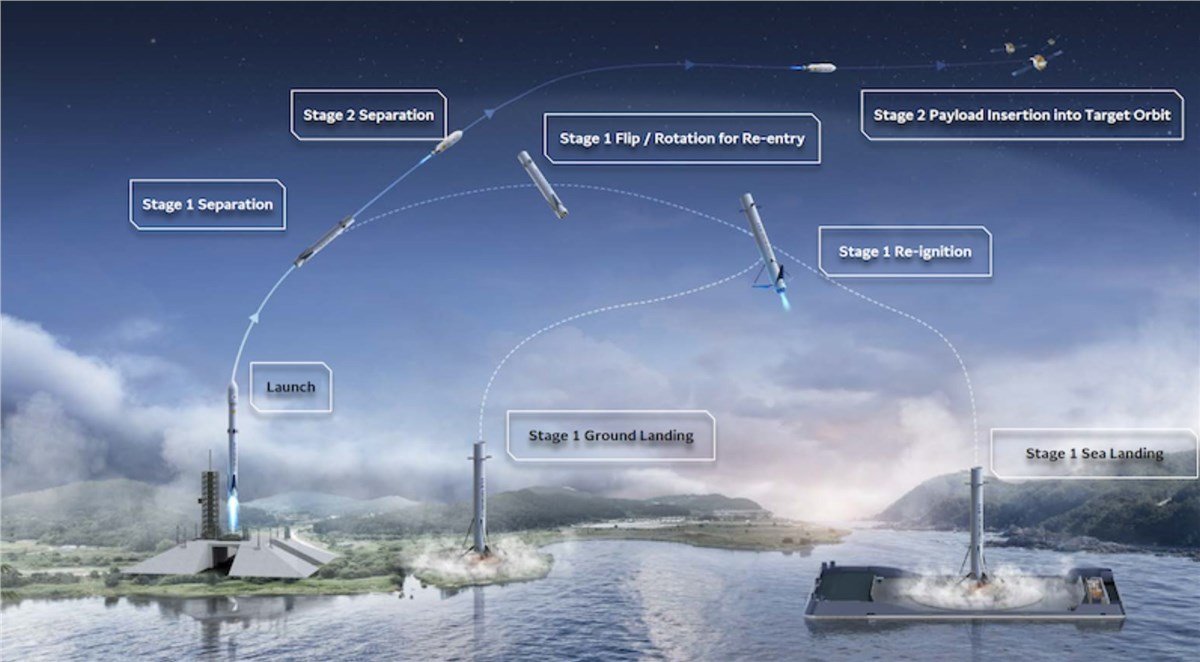
In a significant move to secure Korea’s future in space, Korean Air and Hyundai Rotem have formally launched a joint venture to co-develop a reusable 35-ton-class methane rocket engine. Overseen by the Korea Research Institute for Defense Technology Planning and Advancement (KRIT) and supported by a 49 billion won budget, the project targets completion by October 2030.
The ambitious program officially commenced with a kick-off meeting in Daejeon, attended by over 70 officials from government bodies—including the Ministry of National Defense and the Defense Acquisition Program Administration (DAPA)—academia, and a consortium of industry partners. These partners, essential to the engine’s ecosystem, include Doosan Enerbility, Perigee Aerospace, the Korea Institute of Industrial Technology, and leading universities such as Seoul National University.
Methane is rapidly becoming the global standard for next-generation reusable rockets, favored for its high efficiency, cleaner burn, and reduced soot accumulation compared to traditional kerosene—key for engines designed to launch multiple times. By pursuing this technology, the Korean partnership aims to close the gap with industry pioneers like SpaceX and Blue Origin.
Within the collaboration, Korean Air will spearhead development of the engine’s critical heart: the turbopump. This component must perform under extreme conditions, compressing liquid methane and oxidizer at cryogenic temperatures below -180°C while rotating at tens of thousands of revolutions per minute. “We are applying our aerospace expertise to create a high-performance, reliable turbopump specifically for methane propulsion,” said Kyungnam Kim, Head of Korean Air’s Aerospace R&D Center.
The initiative’s goals extend beyond technical achievement. It is strategically designed to bolster national defense capabilities, particularly for launching military satellites, and to fuel Korea’s burgeoning commercial “New Space” industry. KRIT President Jae Hong Son emphasized the program’s broader importance, stating, “Developing this engine is pivotal for establishing Korea’s leadership in space defense. We are committed to building an innovative R&D framework and a strong defense-space ecosystem to ensure its success.”
By uniting major industrial players under a state-backed framework, the project seeks to deliver a core indigenous technology that will propel Korea into the forefront of the modern space race.
