

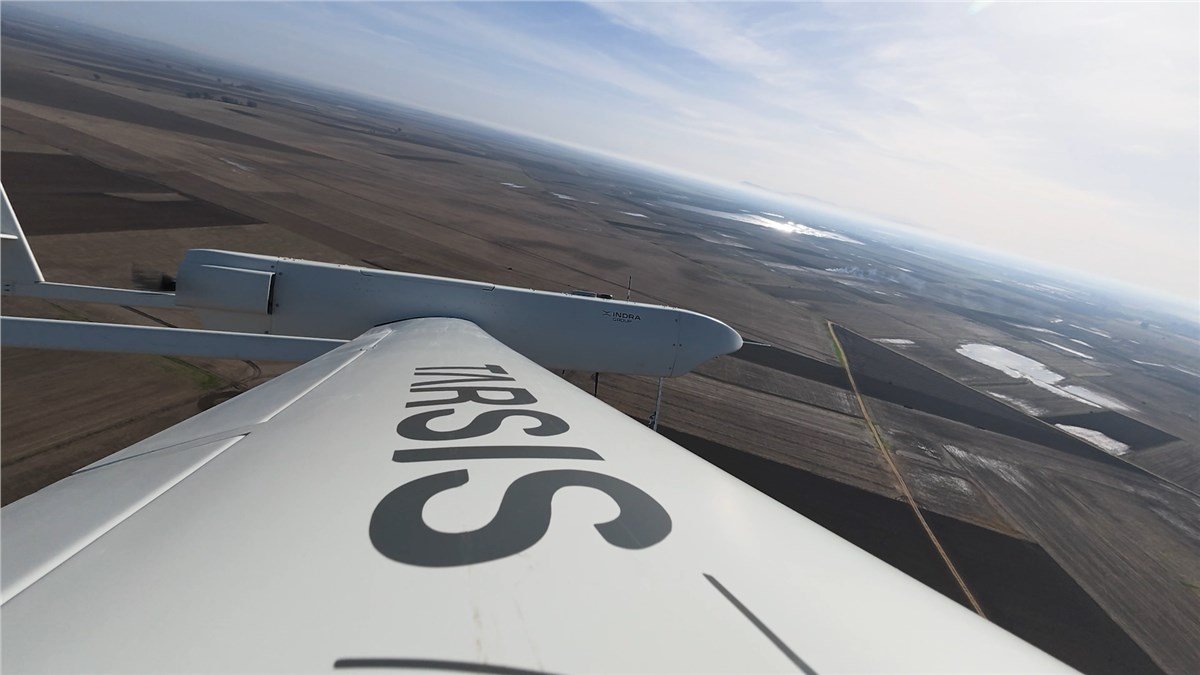
Indra has successfully validated its new onboard detect-and-avoid (DAA) system, a critical technology for the future of unmanned aviation. Developed within the strategic framework of the Galician Aerospace Hub through a joint venture with Tecnobit-Grupo Oesía, the system was trialed on a multirotor drone equipped with a suite of cameras and radar.
During recent flight tests at the Aerohíspalis airfield in Seville, the platform demonstrated its core capability by identifying another Indra TARSIS-family UAV at distances up to one kilometer and autonomously executing optimal avoidance maneuvers. The trials recreated realistic flight profiles with varying trajectories, altitudes, and speeds, proving the system’s effectiveness across a range of scenarios within a UTM (Unmanned Traffic Management) environment, from low-level operations up to 2,000 meters.
This advancement is pivotal for enabling complex, high-density operations such as coordinated drone swarms and for ensuring the safe integration of unmanned aircraft into shared airspace. Indra’s system differentiates itself through sophisticated sensor fusion, combining data from a 360-degree multi-camera array—capable of discriminating small, distant objects—with input from an advanced electronically steered radar. This radar is essential for maintaining operational safety in adverse weather or low-visibility conditions. Robust onboard processing power runs advanced algorithms that synthesize this data in real-time, enabling swift and reliable navigational decisions.
The successful tests mark a decisive step forward for the collaborative project. Indra and Tecnobit-Grupo Oesía are now focusing on developing specialized drone-based solutions for civil protection missions, including search and rescue, marine spill detection, and forest firefighting. To meet these demanding applications, the partners are engineering new VTOL (Vertical Take-Off and Landing) UAS platforms. These drones will feature hybrid electric-combustion propulsion for extended endurance and the flexibility to carry payloads of up to 20 kilograms, directly addressing the growing market need for versatile, medium-lift unmanned systems.
