

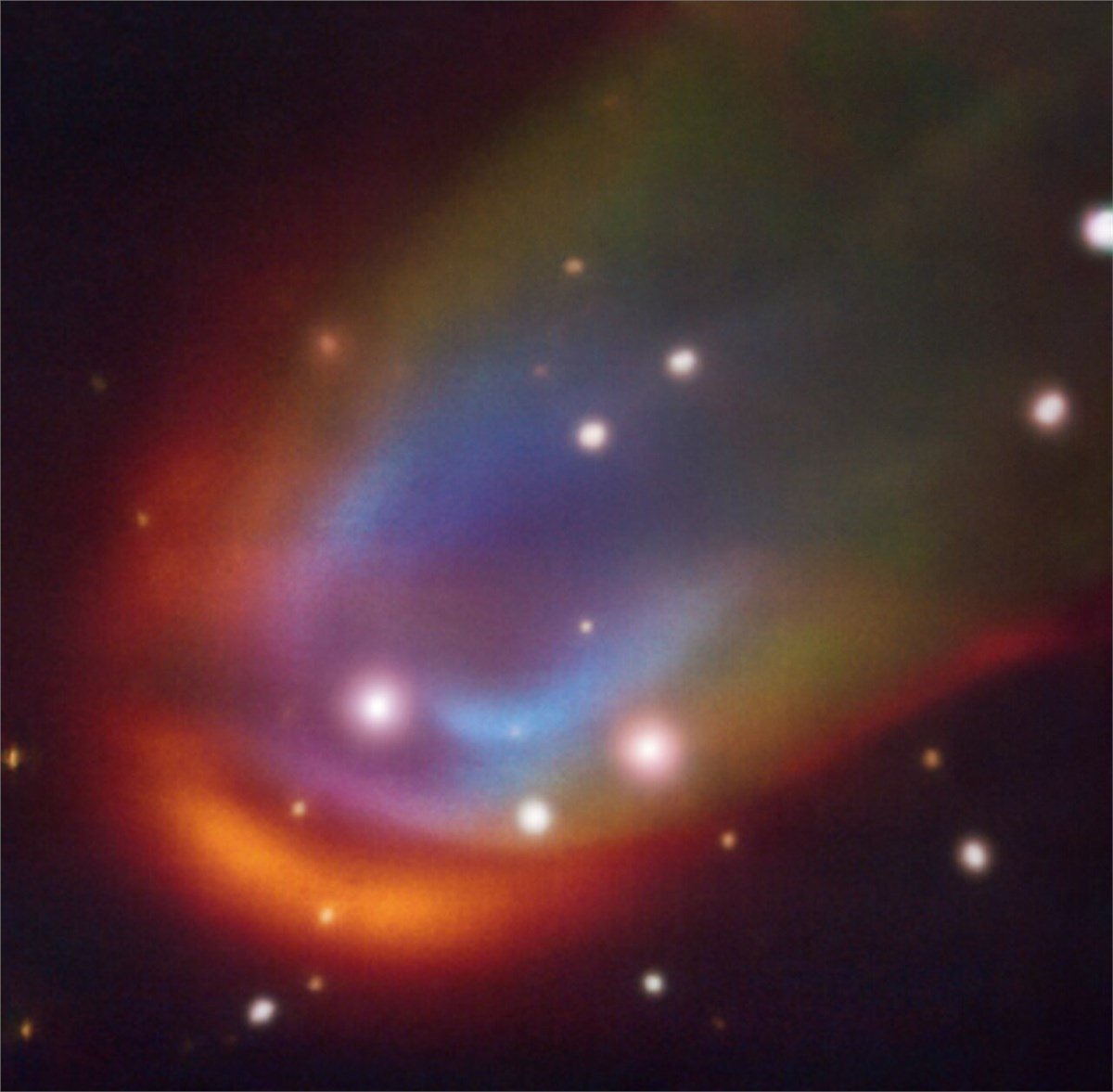
Astronomers have captured a stunning and baffling image of a vast shock wave surrounding a dead star, a discovery that defies current scientific understanding. Using the European Southern Observatory’s Very Large Telescope, researchers observed a bright “bow shock” nebula around the white dwarf RXJ0528+2838, located 730 light-years away. This curved structure, similar to the wave ahead of a ship, is created as the star plows through interstellar gas. The profound mystery is that, according to all known mechanisms, this particular star should not possess such a feature.
The white dwarf orbits a Sun-like companion star in a binary system. Typically, in such pairings, material from the companion star flows onto the white dwarf, forming a glowing disc that can power outflows. However, RXJ0528+2838 shows absolutely no evidence of this crucial disc. “We found something never seen before and, more importantly, entirely unexpected,” says study co-lead Simone Scaringi of Durham University, UK. “Our observations reveal a powerful outflow that, according to our current understanding, shouldn’t be there.”
The key to the puzzle may lie in the white dwarf’s powerful magnetic field. Data suggest this field is so strong it channels stolen material directly onto the star’s surface, bypassing the formation of a disc entirely. “This discovery challenges the standard picture,” explains co-lead Krystian Ilkiewicz. It reveals an unknown mechanism where magnetic forces alone can generate persistent outflows. The shock wave’s scale indicates this hidden “engine” has been active for over a thousand years.
However, the current magnetic strength only accounts for a few centuries of activity, meaning the full power source remains elusive. To solve this, astronomers plan to search for similar systems, a task that will be greatly enhanced by ESO’s upcoming Extremely Large Telescope. This enigmatic bow shock, as beautiful as it is perplexing, has opened a new window into the hidden and powerful dynamics of dead stars.
