

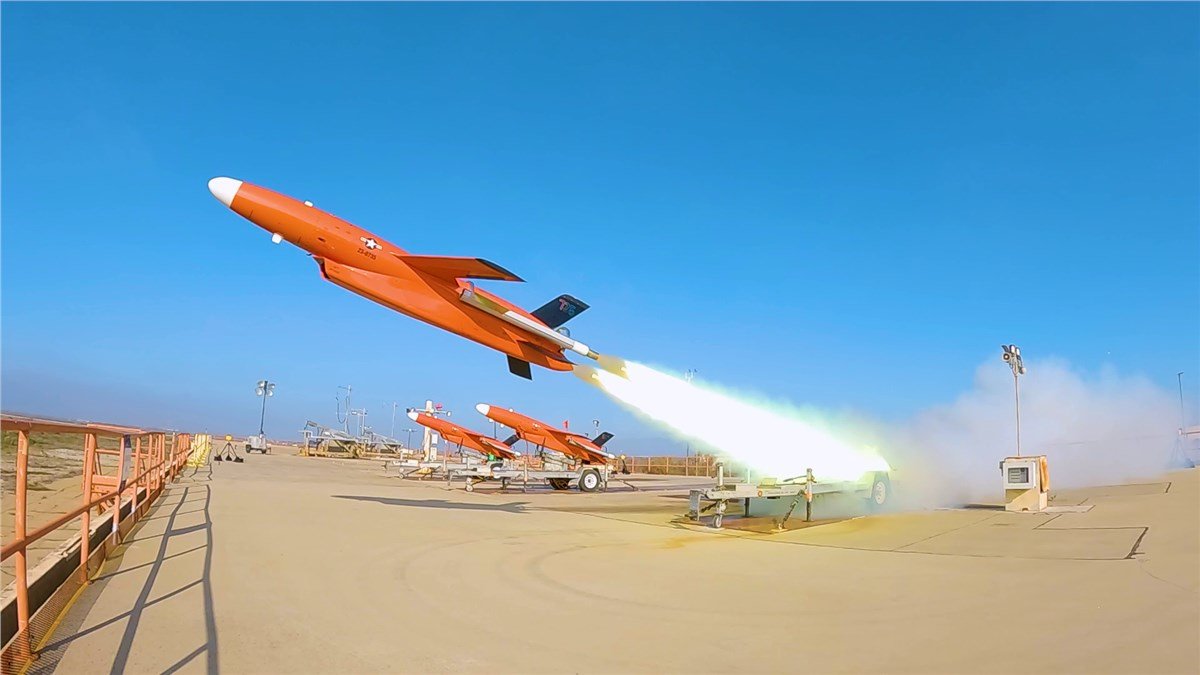
The U.S. Navy has conducted a second successful demonstration of autonomous, AI-driven aircraft, a major step toward its vision for Collaborative Combat Aircraft (CCA). The December 11th event at the Point Mugu Sea Range in California focused on maturing manned-unmanned teaming, where AI-controlled systems operate seamlessly with piloted assets.
During the test, two modified BQM-177A subsonic aerial targets flew autonomously using Shield AI’s Hivemind software. They were integrated into a Live Virtual Constructive (LVC) environment alongside a virtual F/A-18 fighter jet and two simulated adversary aircraft. In the scenario, the virtual F/A-18 acted as a mission commander, directing the autonomous BQM-177As to defend designated airspace. The AI-controlled aircraft successfully responded to the movements of the simulated threats, showcasing coordinated defensive behavior.
“This demonstration is an important step toward advancing autonomous capabilities for the fleet,” said Rear Adm. Tony Rossi, Program Executive Officer for Unmanned Aviation and Strike Weapons. “Integrating AI-enabled autonomy across manned and unmanned platforms will be critical as the Navy develops next-generation air wing concepts.”
The event also marked a key technical achievement: the first fully autonomous flight of an aircraft executing a mission beyond its remote operator’s visual range. “This is laying the foundation for autonomous mission planning in the future,” said Veronica Wesson, a lead with the Strike Planning program office. She also highlighted that the project was completed in just 16 months using new agile contracting methods.
Industry collaboration was central to the effort. Shield AI served as the lead systems integrator and autonomy provider, Kratos supplied the BQM-177A aircraft, and CTSI delivered the mission planning interface. Critically, the test successfully implemented the Navy’s new Autonomy Government Reference Architecture (A-GRA), a set of standards designed to ensure future AI systems can work together across different platforms.
The demonstration builds upon a foundational test in August that validated core autonomous flight controls. By using existing aerial targets as surrogate platforms, the Navy accelerates testing and development at a lower cost before transitioning technology to future operational CCA. The service plans additional development and fleet exercises with this autonomous capability starting in 2026.
