

Electra, a leader in advanced air mobility, has secured three new U.S. patents protecting the core architecture of its hybrid-electric aircraft designed for ultra short takeoff and landing (USTOL) capabilities. The patents cover critical systems for flight path control, pilot guidance displays, and battery management.
The newly granted patents include systems for controlling the flight path of a blown lift aircraft (US Pat. #12384550), a specialized pilot guidance display (U.S Pat. #12298151), and a battery disconnect system that enhances maintenance and safety (U.S Pat. #12489181). Together, they form the foundational IP for Electra’s approach to practical, certifiable hybrid-electric flight.
“These patents protect our unique ability to manage power and lift safely in a scalable configuration,” said Chris Courtin, Electra’s Director of Technology Development. “Instead of traditional control surfaces, our distributed propulsion system actively uses the motors to control the aircraft. This reduces pilot workload and allows our ultra short aircraft to fly just like any other fixed-wing plane.”
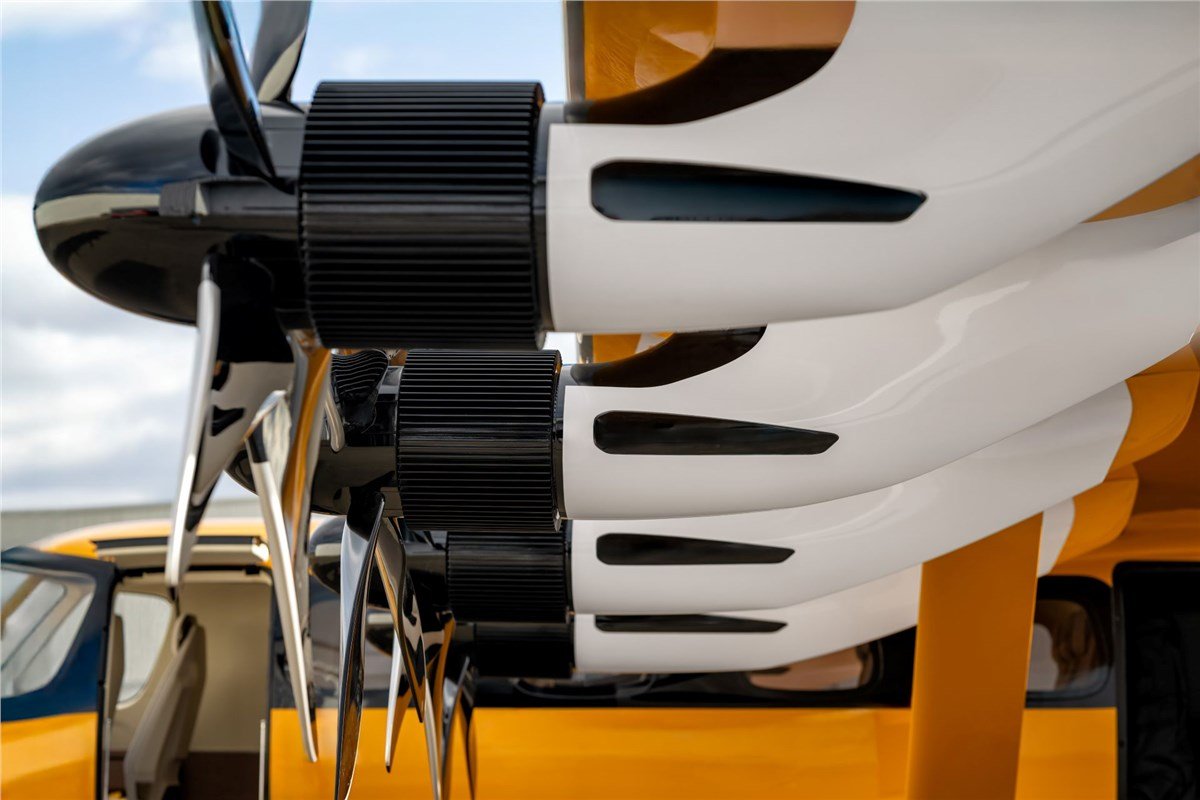
The flight path control patent describes a closed-loop system where pilots command the aircraft’s angle through a single integrated interface. Rather than managing multiple throttles, the pilot selects a mode—such as takeoff or cruise—and onboard computers automatically adjust thrust across multiple electric propulsors to maintain the desired path. This architecture enables Electra’s blown-lift approach, where distributed propulsors mounted along the wing accelerate airflow to dramatically increase lift at low speeds, allowing takeoffs and landings in under 150 feet.
Unlike fully electric aircraft, Electra’s hybrid-electric design uses a turbogenerator to continuously power distributed propulsors, eliminating dependence on ground charging infrastructure. This enables long-range operations from existing runways, parking lots, or small fields, offering helicopter-like versatility with fixed-wing safety and economics.
Electra’s EL2 technology demonstrator has already validated the hybrid-electric system in flight. The company is now advancing toward commercialization of its nine-passenger EL9 aircraft, targeting first test flights in 2027 and entry into service under FAA Part 23 regulations by late 2029.
With over 2,200 pre-orders from more than 60 customers worldwide, the EL9 represents one of the most significant commercial programs in the advanced air mobility sector, positioning Electra to pioneer Direct Aviation—a model connecting underserved communities through efficient, infrastructure-flexible air travel.
