

Imagine a spacecraft that can heal its own cracks like living skin. That future is closer thanks to a new partnership developing self-repairing composites for space travel.
Swiss companies CompPair and CSEM, along with Belgium’s Com&Sens, have teamed with the European Space Agency (ESA) on Project Cassandra. The initiative integrates sensors and heating elements into carbon fiber materials, enabling spacecraft to autonomously repair minor damage before it becomes critical.
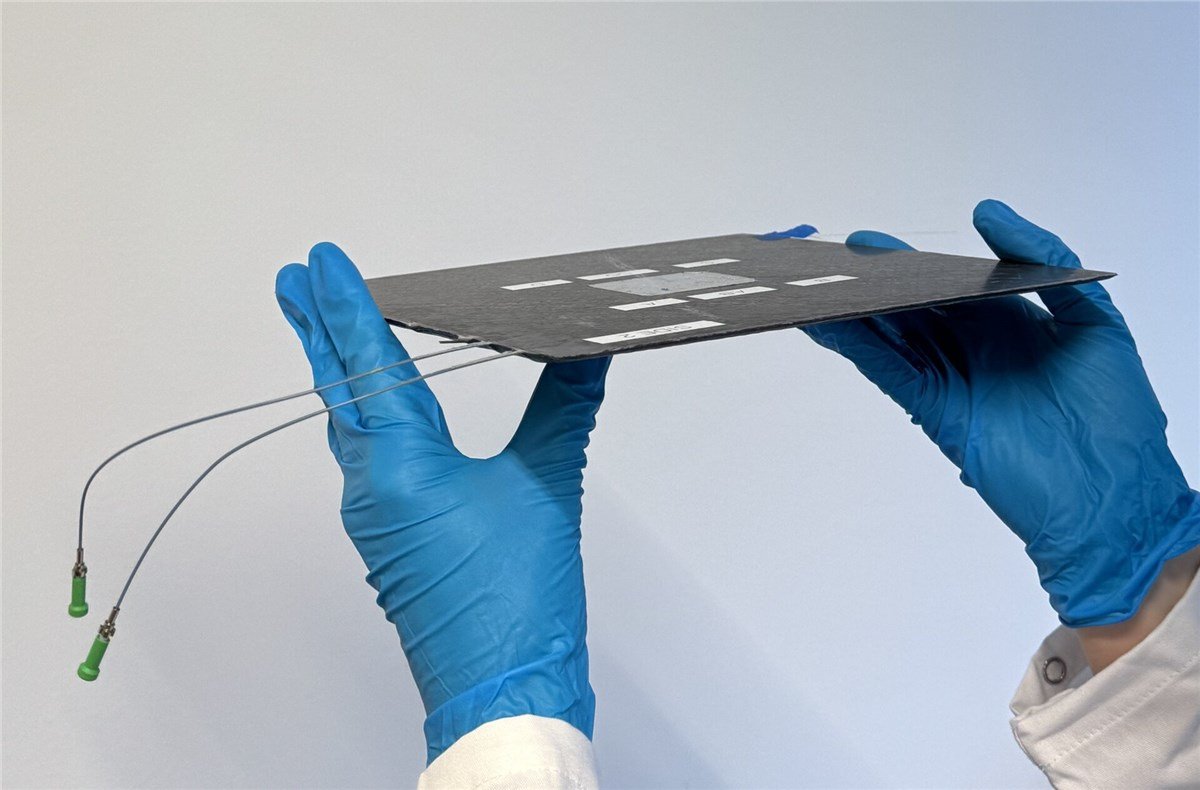
The technology builds on CompPair’s existing “HealTech” system. When heat is applied to the composite, a specialized agent inside the material activates and flows to fill cracks caused by impact or stress. For space applications, this process is triggered automatically when embedded fiber-optic sensors detect structural issues, with 3D-printed aluminum grids heating the affected area to 100–140°C.
Composite materials like carbon fiber reinforced polymers have become essential in spacecraft construction due to their strength and light weight. However, they remain vulnerable to damage from repeated space travel, and traditional repairs are costly, time-consuming, and often compromise structural integrity.
Project Cassandra addresses this vulnerability through an integrated approach. A network of optical fiber sensors continuously monitors the structure for damage. Once identified, the healing cycle activates automatically, potentially extending spacecraft lifespan without human intervention.
Testing has progressed from small 2×10 cm samples to 40×40 cm panels, evaluating damage detection, heating uniformity, and healing effectiveness. Researchers have also subjected materials to thermal shock tests simulating cryogenic tank conditions, with promising results. The next phase will adapt the technology for larger structures like complete fuel tanks.
ESA’s Bernard Decotignie sees transformative potential: “Implementing this technology could have enormous benefits for space transportation. It will help develop reusable space infrastructure and reduce mission costs.”
The implications extend beyond individual missions. Self-healing materials could dramatically reduce space debris by extending vehicle life and prove essential for reusable launchers. For long-duration missions to Mars or beyond, autonomous repair capabilities could mean survival when human intervention isn’t possible.
CompPair’s Cecilia Scazzoli notes the technology has already demonstrated resistance to micro-cracking while maintaining autonomous sensing and healing abilities. “This makes them suited to the demanding requirements of propellant tanks and reusable space structures, and paves the way for lighter, more maintainable spacecraft components.”
As space exploration pushes toward greater autonomy and sustainability, self-healing materials represent a critical enabling technology. Project Cassandra, part of ESA’s FIRST! initiative, demonstrates how European innovation is turning science fiction into practical engineering for the next generation of space transportation.
