

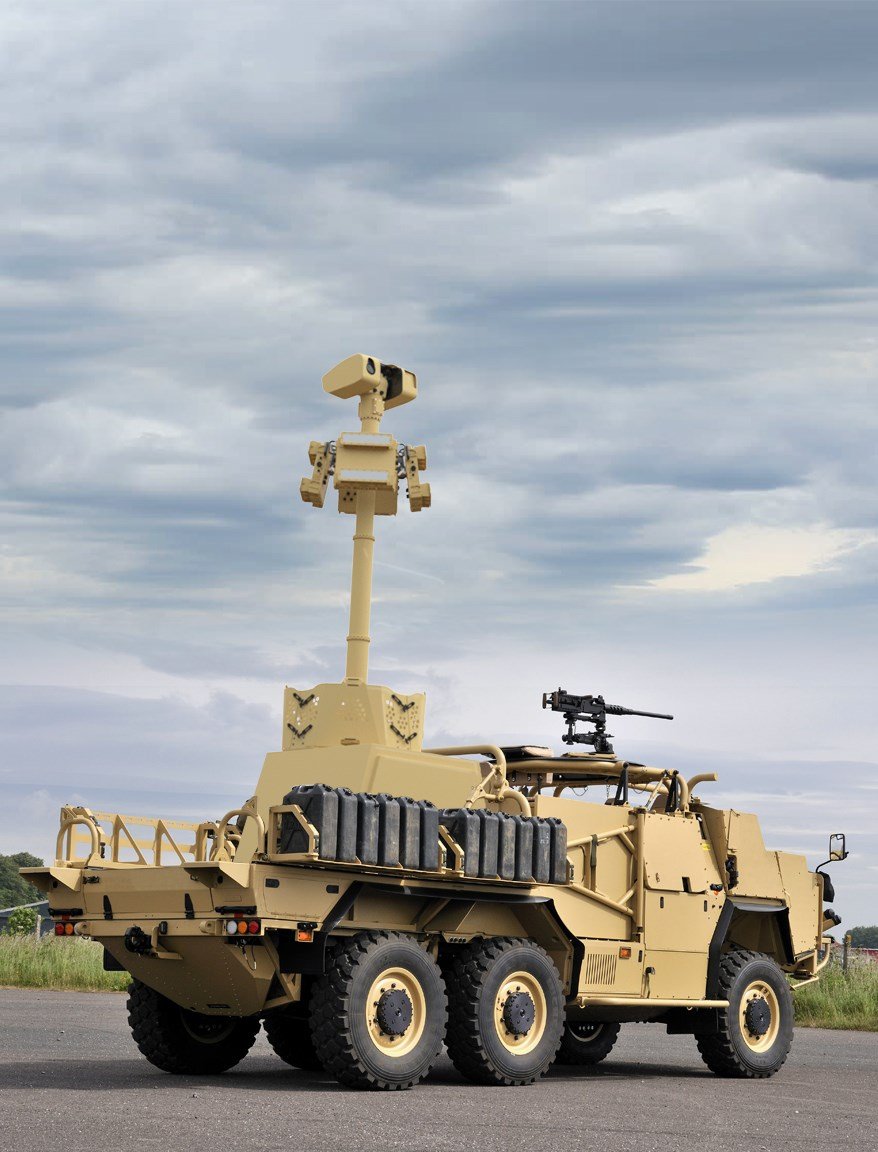
Blighter Surveillance has announced a series of upgrades to its e-scan radars, enhancing their Low-Probability-of-Intercept (LPI) characteristics to meet the rigorous demands of modern crewed and autonomous surveillance vehicles. With electronic warfare threats growing more sophisticated, the requirement for radars that can “see but not be seen” has become critical, particularly in mobile applications where stealth and data security are non-negotiable.
The core of Blighter’s approach lies in its fundamental architecture. Unlike traditional rotating radars, Blighter’s solid-state, non-rotating design utilizes a dual-antenna FMCW (Frequency Modulated Continuous Wave) configuration. Operating in the Ku-band, this design naturally produces a signal that is exceptionally difficult for electronic support measures to detect. According to CTO Mark Radford, this inherent covertness is a result of design choices made at the company’s inception, creating a radar that is both electronically robust and stealthy.
Recent enhancements have amplified these innate qualities. The introduction of faster scanning modes with sub-second update rates ensures that minimal radar energy is emitted in any single direction. When paired with the BlighterNexus ‘Scan-Manager’ software, the radar operates in a Multi-Function Radar mode, adding layers of randomization to its complex, low-power waveforms. The result is a radar that maintains its industry-leading detection and classification of people, vehicles, and airborne threats while becoming even harder to jam.
The practical benefits for system integrators are significant. The radar’s extremely low transmit power—just 4 Watts—reduces its electromagnetic and acoustic footprint, easing integration challenges on sensitive platforms like electric or hybrid autonomous vehicles. This proved decisive in 2025, leading to its integration into European border surveillance fleets, Allen-Vanguard’s SECURIS counter-drone system, and military patrol vehicles in Southeast Asia. “The complexity of our combined e-scan, FMCW, and Doppler chirp waveforms is what makes us so difficult to detect,” Radford stated, reinforcing the radar’s position as a premier covert sensor for modern mobile defence programmes.
