

Scientists using ESA’s Cheops satellite have discovered a planetary system that defies conventional wisdom about how planets form. The star LHS 1903 hosts four planets arranged in a baffling order: rocky, gaseous, gaseous, and then rocky again.
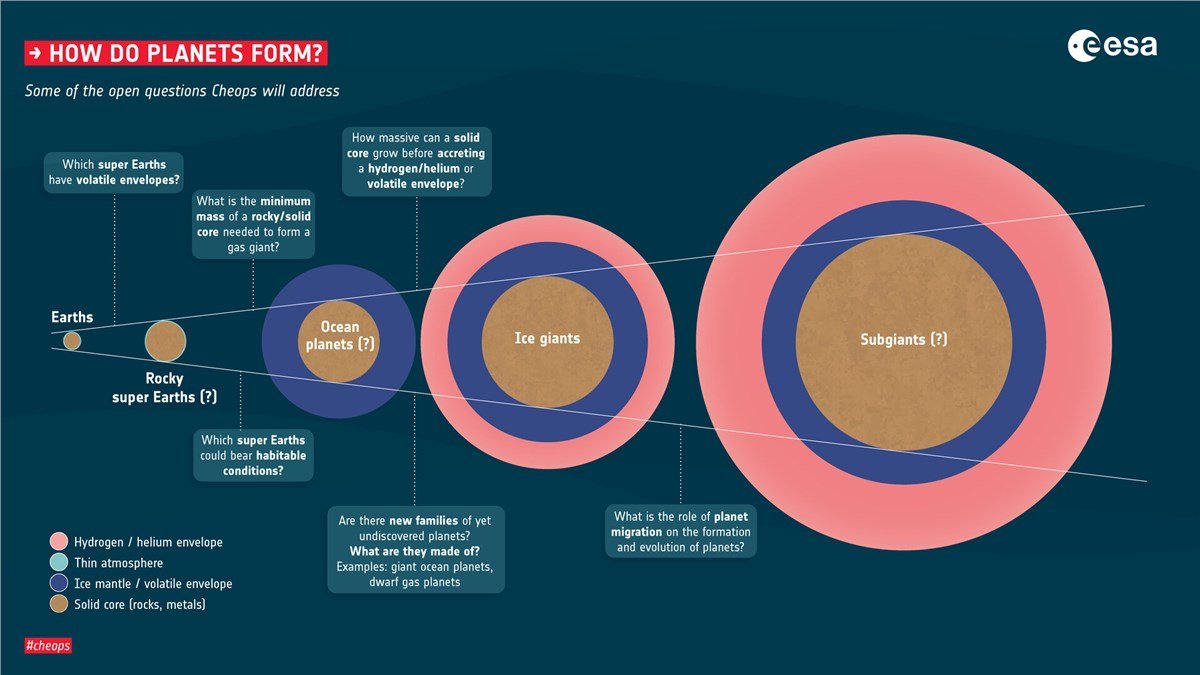
This discovery challenges the fundamental rule of planetary formation. Normally, planets closest to their star are small and rocky because stellar radiation strips away any gaseous envelope. Further out, where temperatures drop, planets can accumulate thick atmospheres and become gas giants.
The LHS 1903 system follows this pattern for its first three planets. But Cheops data revealed a fourth planet orbiting farthest from the star—and it appears to be rocky.
“That makes this an inside-out system,” said Thomas Wilson of the University of Warwick. “Rocky planets don’t usually form so far away from their home star.”
The international research team explored possible explanations. Could a massive collision have stripped the planet’s atmosphere? Had the planets swapped positions over time? Computer simulations ruled out both scenarios.
Instead, scientists arrived at a more fascinating possibility: these planets may have formed one after another, not simultaneously. The outermost world appears to be a “late bloomer” that developed after the system’s planet-forming gas had largely dissipated.
“By the time this outer planet formed, the system may have already run out of gas,” Wilson explained. “Yet here is a small, rocky world, defying expectations.”
This evidence supports a decade-old theory called “inside-out planet formation,” where planets form sequentially from the inner system outward. If confirmed, it would fundamentally alter our understanding of planetary evolution.
ESA project scientist Maximilian Günther noted that finding such clues is precisely what Cheops was designed to do. “Much about how planets form and evolve is still a mystery.”
The discovery also raises questions about our Solar System’s place in the cosmic order. Isabel Rebollido, ESA Research Fellow, observed that planet formation theories have historically been based on our local neighborhood. As we discover more exotic systems, those assumptions are being tested.
Whether LHS 1903 represents a rare outlier or the first evidence of a common but previously unknown planetary trend remains uncertain. Either way, this small rocky world far from its star demands explanations beyond current theories, reminding us that the Universe still holds surprises about how worlds come to be.
