

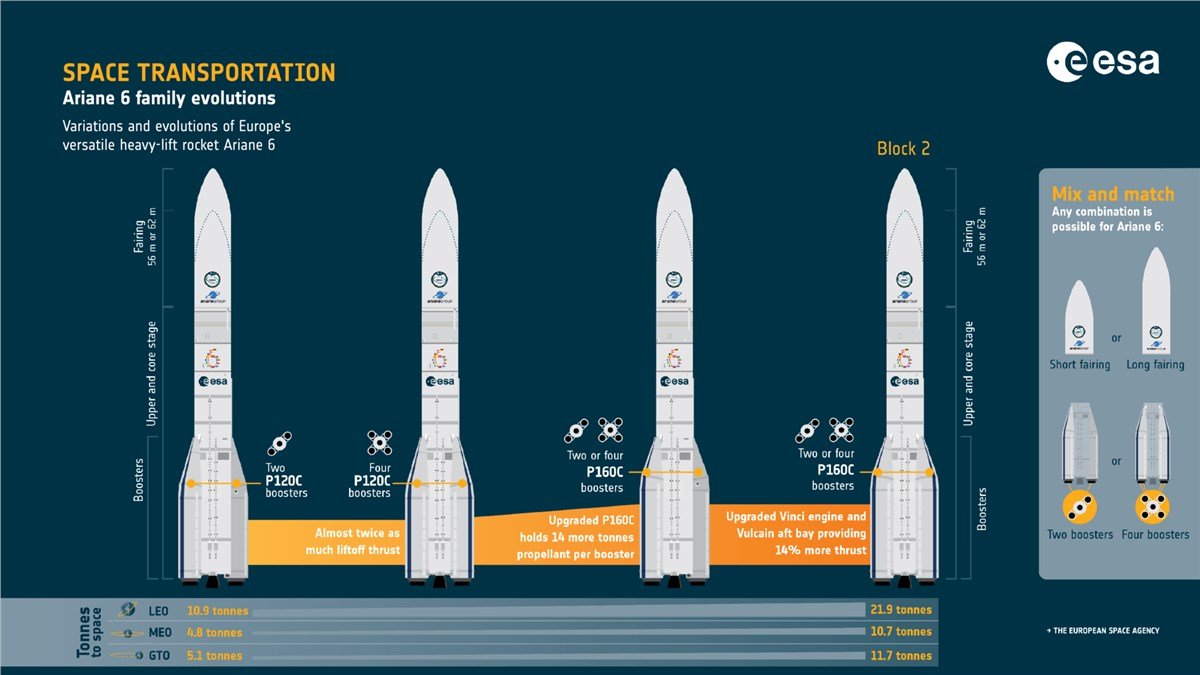
Europe’s space capabilities reached a new pinnacle, as the Ariane 6 rocket thundered off the launch pad in its most powerful configuration yet. For the first time, four P120C boosters ignited simultaneously, lifting the heavy-lift vehicle and 32 satellites into low-Earth orbit from Europe’s Spaceport in French Guiana.
The mission, operated by Arianespace, marked the inaugural flight of the Ariane 64 variant—a version that doubles the rocket’s performance compared to its two-booster counterpart. With liftoff at 13:45 local time, the rocket’s main stage and four strap-on boosters worked in perfect synergy to generate the thrust needed to haul approximately 21.6 tonnes to orbit, more than double the capacity of the Ariane 62.
Standing 62 metres tall, this iteration of Ariane 6 was the tallest yet built, thanks to a 20-metre-long fairing designed to house the 32 satellites for Amazon’s Kuiper constellation. The mission demonstrated not only raw power but also precision. The upper stage’s auxiliary propulsion unit enabled the deployment of all satellites just 114 minutes after liftoff, showcasing the vehicle’s suitability for modern constellation missions. A final burn of the upper stage ensured a controlled deorbit, aligning with ESA’s zero-debris policy.
ESA Director General Josef Aschbacher hailed the moment as a turning point. “With the powerful roar of four boosters at liftoff comes more than double the payload mass to orbit. Europe is back on stage for launching all satellites to all orbits,” he said.
The success validates Europe’s autonomous access to space, a goal reinforced by ESA’s Director of Space Transportation, Toni Tolker-Nielsen. He emphasized that with Vega-C, Ariane 62, and now Ariane 64, the continent possesses a complete and versatile rocket fleet capable of serving any mission requirement.
The achievement is the result of broad European collaboration. Led by prime contractor ArianeGroup, the program involves a network of industrial partners across 13 countries, with CNES managing launch range operations and Arianespace serving as the service provider.
Looking ahead, ESA is already preparing upgrades. The P120C boosters will eventually be replaced by the more powerful P160C models, which were successfully tested in April 2025. These longer motors carry over 14 tonnes of additional solid fuel, promising even greater performance for future missions, including the launch of ESA’s planet-hunting Plato spacecraft.
