

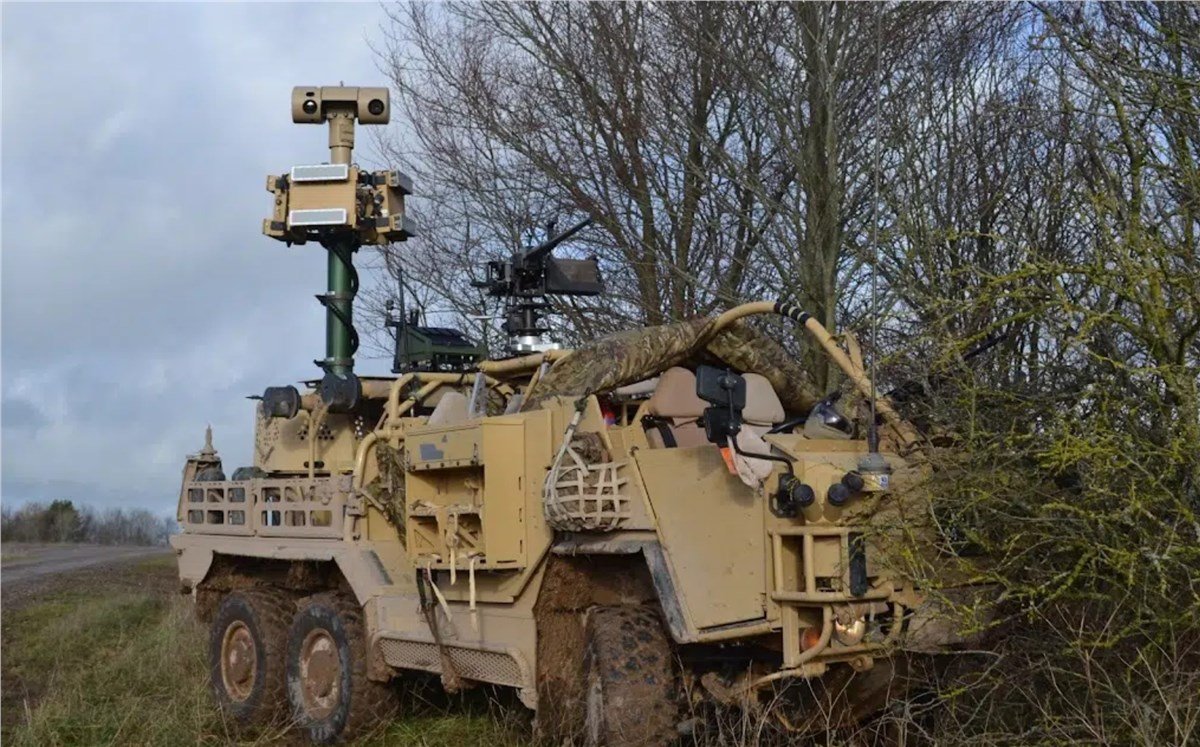
Blighter Surveillance Systems has advanced the stealth features of its e-scan radar family to meet growing demand from manufacturers of crewed and autonomous multi-sensor surveillance vehicles. The upgrades respond to increasing requirements for Low-Probability-of-Intercept (LPI) capabilities as electronic counter-countermeasures become more sophisticated.
The company’s B400 series radars utilise LPI waveforms that make signals difficult to detect and jam while maintaining exceptional performance in detecting people, vehicles and low-altitude airborne threats. According to Blighter CTO Mark Radford, the radar’s inherent covert nature stems from original design choices including solid-state construction, non-rotating electronic scanning, dual antenna FMCW architecture and Ku-band operation.
Recent enhancements include fast scanning modes with sub-second update rates that reduce energy transmission in any specific direction. When combined with BlighterNexus’ Scan-Manager Application Module, the radar operates in Multi-Function Radar mode with greater randomisation of low-power waveforms.
Low Probability of Intercept Explained
LPI represents a radar design philosophy focused on preventing emissions from detection by enemy receivers. Key characteristics include low peak power transmission, complex coded waveforms, frequency agility, advanced scanning patterns and high processing gain. These features combine with low side-lobe antennas to confine energy tightly within the main beam, making interception extremely difficult.
The approach emerged during the late Cold War period as electronic support receivers grew increasingly sensitive. Today, demand for LPI capabilities grows as threats evolve and defence modernisation programmes prioritise stealth and information superiority.
Practical Applications and Integration Benefits
Blighter’s solid-state design operates at just 4 watts transmit power, reducing electromagnetic compatibility issues and acoustic signatures while creating smaller safety zones around the radar. This facilitates integration into electric and hybrid autonomous platforms where power efficiency and low observability are critical.
In 2025, Blighter radars were incorporated into multiple mobile surveillance programmes including custom-built vehicles for European border monitoring, Allen-Vanguard’s SECURIS counter-drone system, and Southeast Asian military border surveillance vehicles.
The radars provide continuous surveillance coverage detecting moving vehicles, personnel and aerial threats at ranges up to 32 kilometres. Their compact, modular design supports rapid deployment on towers, vehicles or as portable tripod-mounted systems, making them suitable for modernisation programmes, patrol vehicles and target designation platforms.
