

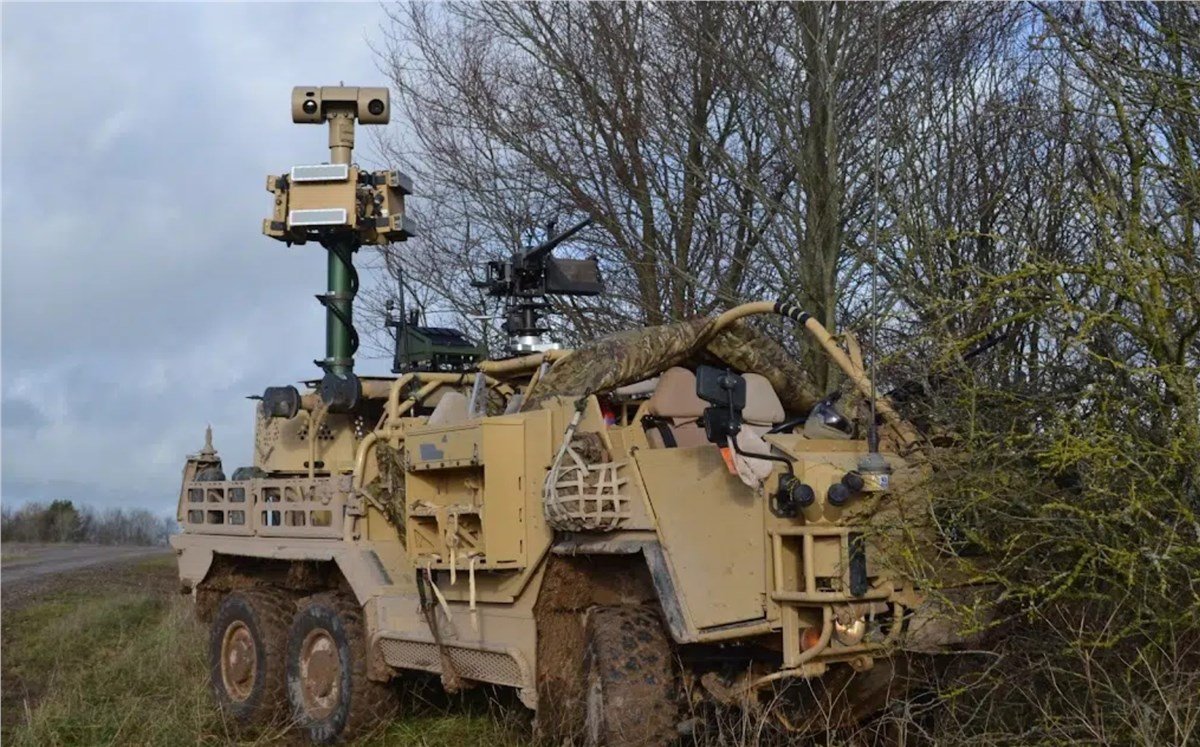
Blighter has enhanced the Low-Probability-of-Intercept (LPI) characteristics of its electronic-scanning radars. This development directly responds to the rising demand from developers of both crewed and autonomous multi-sensor surveillance vehicles, where covert operation is critical.
The need for stealthier radars is driven by advancing electronic warfare threats. In mobile surveillance, the advantage belongs to systems that can see without being seen, ensuring information superiority and data security. Blighter’s radars, including the B400 series, are engineered for this role. They utilise LPI waveforms, making their signals exceptionally difficult for enemy receivers to detect and jam, without compromising performance in detecting people, vehicles, and low-flying drones.
“The foundation of our covert capability was built into the radar’s architecture from the start,” explains Mark Radford, Blighter’s CTO. “As pioneers of solid-state, non-rotating e-scan ground radar, our choice of a dual-antenna FMCW design and operation in the Ku-band spectrum has resulted in a uniquely resilient and stealthy system.”
Continuous refinements are pushing these stealth features further. New fast-scanning modes with sub-second updates reduce the radar energy transmitted in any single direction. When paired with BlighterNexus software, the radar can operate in a Multi-Function Radar (MFR) mode, randomising its already low-power waveforms for even greater concealment.
Key to this stealth is the combination of solid-state design, very low transmit power (4 Watts), and complex waveform coding. This not only minimises the radar’s electromagnetic and acoustic signature but also simplifies integration onto vehicles by reducing the required safety zone. “Ultimately, it’s the complexity of our combined e-scan, FMCW, and Doppler waveforms that makes the radar so difficult to detect and jam,” Radford notes.
The practical application of this technology is growing. In 2025 alone, Blighter radars were deployed on custom multi-sensor vehicles for European border monitoring, integrated into rapid-deployable counter-drone systems by Allen-Vanguard, and used by a Southeast Asian military for mobile border surveillance.
“Our radar stands as one of the stealthiest and most resilient in its class,” concludes Radford. “It is an ideal solution for modernisation programs and next-generation autonomous or hybrid patrol vehicles where adding a covert surveillance capability is paramount.”
Background on LPI: The LPI design philosophy focuses on preventing radar detection by enemy receivers. It employs techniques like low power, complex waveforms, and frequency agility to hide emissions within the background noise, ensuring the radar can operate covertly.
