

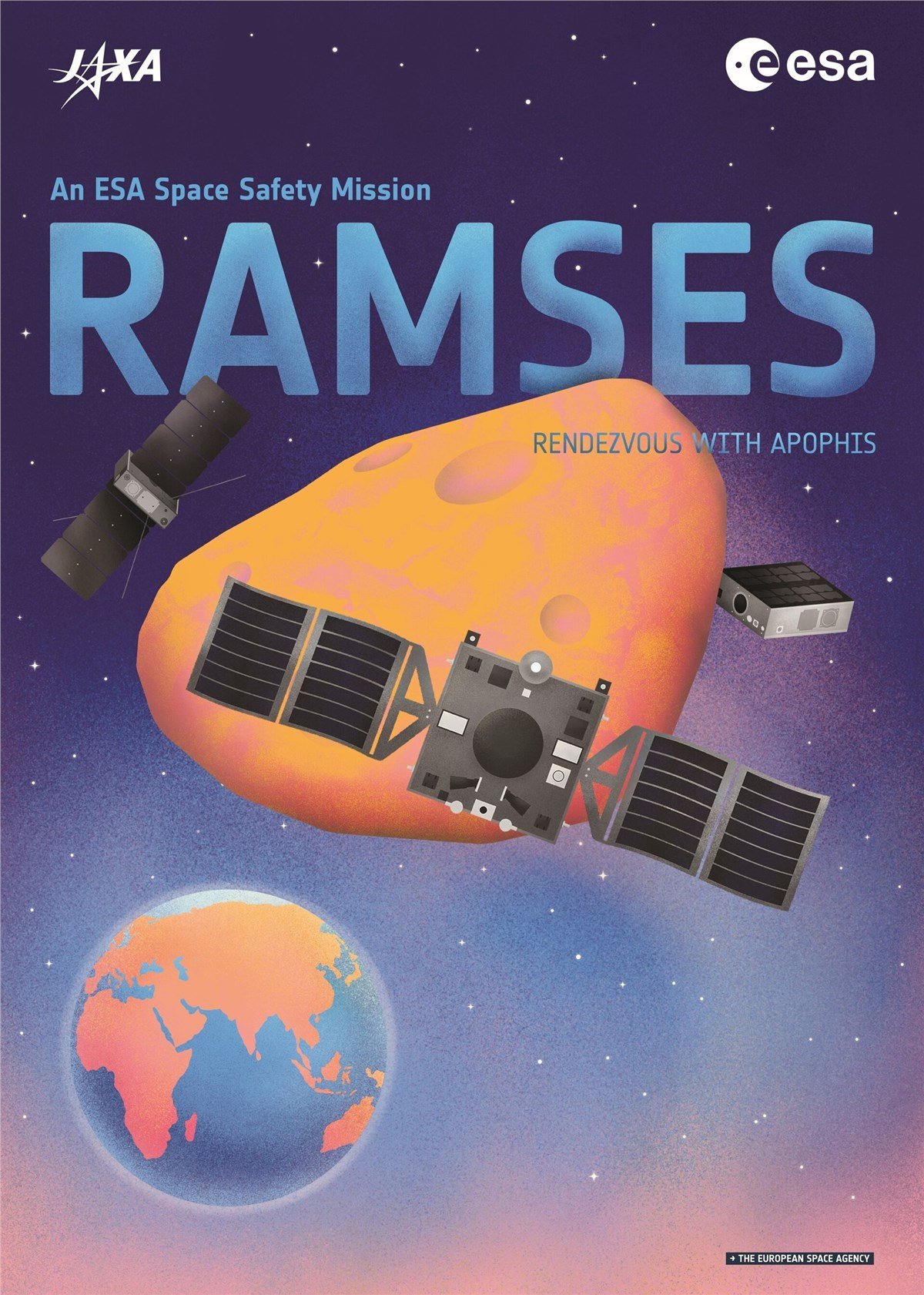
The European Space Agency has formalised its commitment to the Rapid Apophis Mission for Space Safety (Ramses), signing construction contracts worth €89.4 million with Italian industry partners on 10 February 2026.
ESA awarded OHB Italia an €81.2 million contract to build the main Ramses spacecraft, initiating the assembly, integration and testing phase at the agency’s ESTEC facility in the Netherlands. A separate €8.2 million agreement with Tyvak International covers construction of Farinella, one of two CubeSats the mission will deploy. Combined with preparatory work authorised in October 2024, total ESA investment in Ramses now approaches €150 million.
Scheduled for launch in Spring 2028, Ramses will rendezvous with the near-Earth asteroid Apophis ahead of its unprecedented close approach on 13 April 2029. The 375-metre object will pass within 32,000 kilometres of Earth—closer than geostationary orbit—offering scientists a rare natural experiment in planetary defence.
“Ramses seizes a once-in-a-lifetime opportunity to study Apophis as Earth’s gravitational forces alter its shape, spin and structure,” said Orson Sutherland, ESA’s Mars & Beyond Projects Group Leader. “This deepens our understanding of near-Earth objects and advances planetary protection capabilities.”
Roberto Aceti, CEO of OHB Italia, described the contract as “confidence in our team’s expertise and decades-long heritage delivering complex space systems.”
The mission capitalises on European experience from ESA’s Hera asteroid mission, also built by OHB. Like its predecessor, Ramses will carry CubeSats developed by European industry to extend scientific reach. Tyvak’s Farinella—named after Italian planetary scientist Paolo Farinella—follows a €4.7 million preparatory contract awarded last year.
Ramses is a joint endeavour with Japan’s space agency JAXA, contributing solar arrays, a thermal infrared imager, and researchers to the science team. A potential rideshare launch with JAXA’s Destiny+ mission is under consideration.
The mission’s Critical Design Review concluded on 6 February, confirming the spacecraft meets all technical and programmatic requirements. “Passing this milestone in record time endorses the team’s commitment under a demanding schedule,” said mission manager Paolo Martino.
The Ramses mission aims to inform future strategies against potentially hazardous asteroids, supporting ESA’s Space Safety Programme objective to protect Earth from spaceborne threats.
