

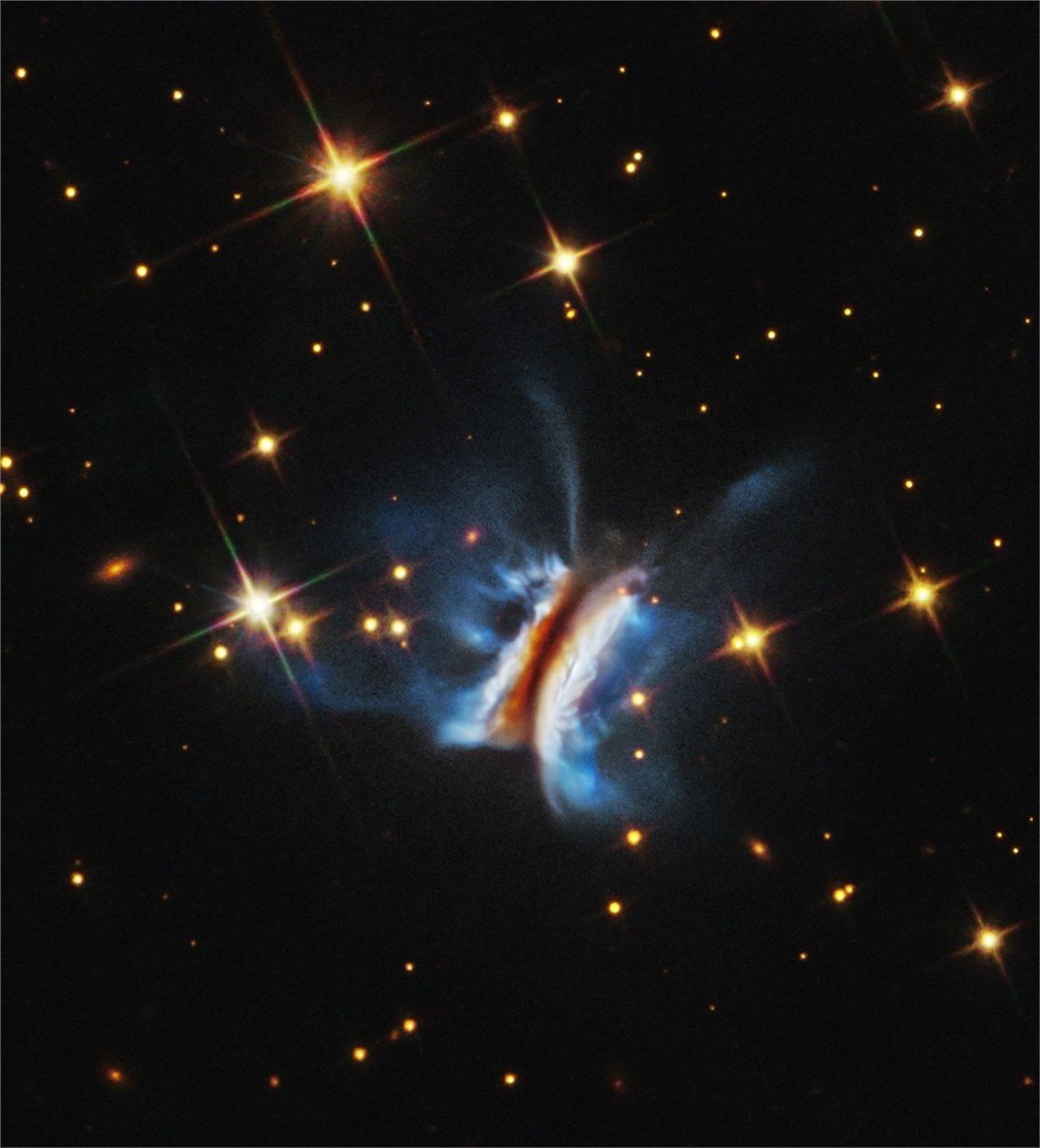
Astronomers using NASA’s Hubble Space Telescope have revealed the largest planet-forming disk ever seen, and it is a uniquely chaotic environment. Spanning a colossal 400 billion miles—40 times the width of our solar system to the Kuiper Belt—the disk, nicknamed “Dracula’s Chivito,” is a turbulent nursery of gas and dust.
For the first time in visible light, Hubble’s detailed images show the disk’s chaotic structure. Dramatic wisps of material stretch far above and below the main disk plane, and these extensive filaments appear only on one side, creating a strikingly lopsided appearance. This asymmetry suggests the disk is being dynamically shaped by ongoing processes, such as the infall of new material or interactions with its surroundings.
“This level of detail is rare,” said lead author Kristina Monsch of the Center for Astrophysics | Harvard & Smithsonian. “We’re seeing that planet nurseries can be far more active and chaotic than we expected.”
Located about 1,000 light-years away, the edge-on disk obscures the central young star or binary star system within it. Its immense size and estimated mass—containing enough material to form 10 to 30 Jupiters—makes it a scaled-up laboratory for studying how planets, including gas giants, are born.
“The asymmetric disk gives us a front-row seat to the chaotic processes shaping new planets,” said co-investigator Joshua Bennett Lovell.
While the extreme environment of “Dracula’s Chivito” may differ from our own solar system’s origins, the fundamental physics of planet formation are likely similar. These unprecedented Hubble observations provide a new starting point for understanding how entire planetary systems emerge from cosmic chaos.
