

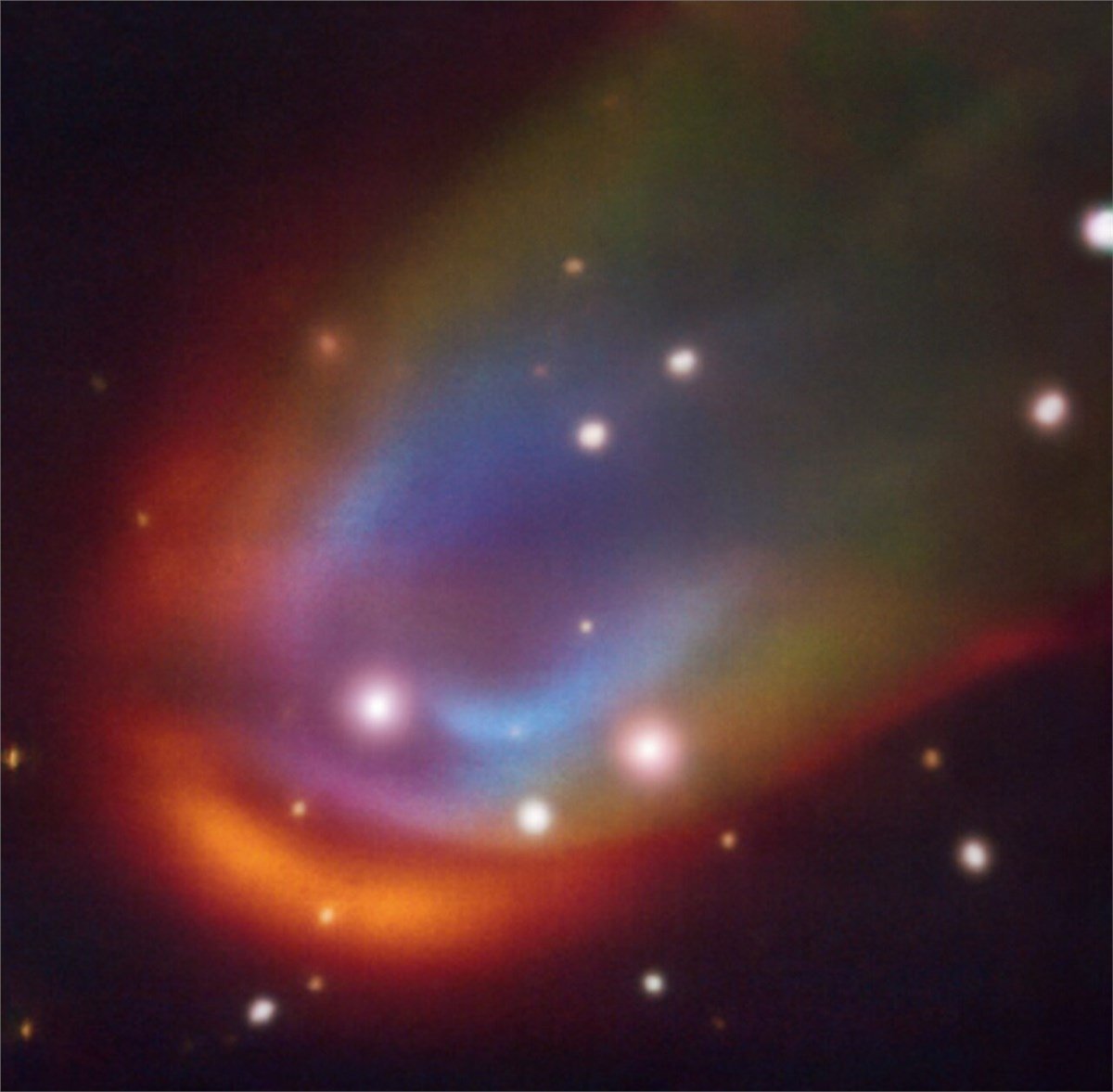
Astronomers have discovered a vast, beautiful shock wave surrounding a white dwarf star, a finding that directly challenges existing theories of how these dead stars behave. The structure, known as a bow shock, is created as the star moves through interstellar gas, but its source—a powerful, sustained outflow of material—should not exist.
The star system, RXJ0528+2838, is a white dwarf with a Sun-like companion. Typically in such pairs, material from the companion forms a disc around the dense white dwarf, and some of this matter is ejected, creating outflows. However, this system shows no signs of an accretion disc.
“We found something never seen before and, more importantly, entirely unexpected,” said study co-lead Simone Scaringi of Durham University. “Our observations reveal a powerful outflow that, according to our current understanding, shouldn’t be there.”
The bow shock, resembling the wave ahead of a ship, implies the white dwarf has been expelling material for over a millennium. The leading hypothesis points to the star’s strong magnetic field. Data from the MUSE instrument on the European Southern Observatory’s Very Large Telescope confirms this field exists and suggests it channels stolen material directly onto the white dwarf’s poles, bypassing the need for a disc entirely.
Yet, the mystery deepens. Calculations show the current magnetic strength is insufficient to power a shock wave of this longevity. “This discovery challenges the standard picture,” said co-lead Krystian Ilkiewicz. “It reveals a mechanism we do not yet understand.”
The team speculates the magnetic field may have been stronger in the past or that another, hidden energy source—a “mystery engine”—is at work. Solving this puzzle requires finding more such systems. Future instruments, like ESO’s upcoming Extremely Large Telescope, will be crucial for this search, potentially uncovering a new chapter in our understanding of stellar evolution and magnetic interactions in the cosmos.
