

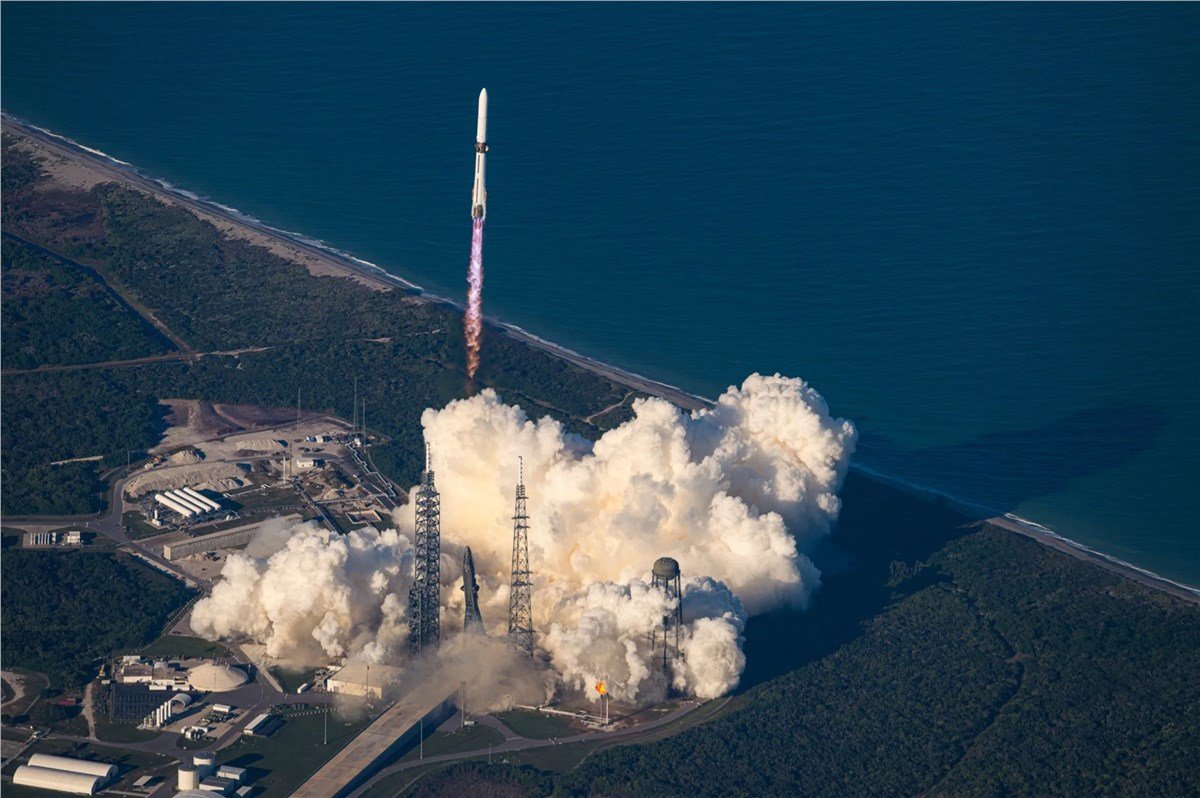
A pair of NASA spacecraft ultimately destined for Mars will study how its magnetic environment is impacted by the Sun. The mission also will help the agency prepare for future human exploration of Mars.
NASA’s ESCAPADE (Escape and Plasma Acceleration and Dynamics Explorers) spacecraft EST, aboard a Blue Origin New Glenn rocket from Launch Complex 36 at Cape Canaveral Space Force Station in Florida.
“Congratulations to Blue Origin, Rocket Lab, UC Berkeley, and all our partners on the successful launch of ESCAPADE. This heliophysics mission will help reveal how Mars became a desert planet, and how solar eruptions affect the Martian surface,” said acting NASA Administrator Sean Duffy. “Every launch of New Glenn provides data that will be essential when we launch MK-1 through Artemis. All this information will be critical to protect future NASA explorers and invaluable as we evaluate how to deliver on President Trump’s vision of planting the Stars and Stripes on Mars.”
The twin spacecraft, built by Rocket Lab, will investigate how a never-ending, million-mile-per-hour stream of particles from the Sun, known as the solar wind, has gradually stripped away much of the Martian atmosphere, causing the planet to cool and its surface water to evaporate. The mission is led by the University of California, Berkeley.
Ground controllers for the ESCAPADE mission established communications with both spacecraft by 10:35 p.m. EST.
“The ESCAPADE mission is part of our strategy to understand Mars’ past and present so we can send the first astronauts there safely,” said Nicky Fox, associate administrator, Science Mission Directorate at NASA Headquarters in Washington. “Understanding Martian space weather is a top priority for future missions because it helps us protect systems, robots, and most importantly, humans, in extreme environments.”
New Glenn also carried a space communications technology demonstration from Viasat Inc., supporting NASA’s efforts to commercialize next-generation satellite relay services for science missions. Funded by the agency’s Communications Services Project, the demonstration transmitted launch telemetry data from the rocket’s second stage to an operations center on Earth through Viasat’s geostationary satellite network.
