

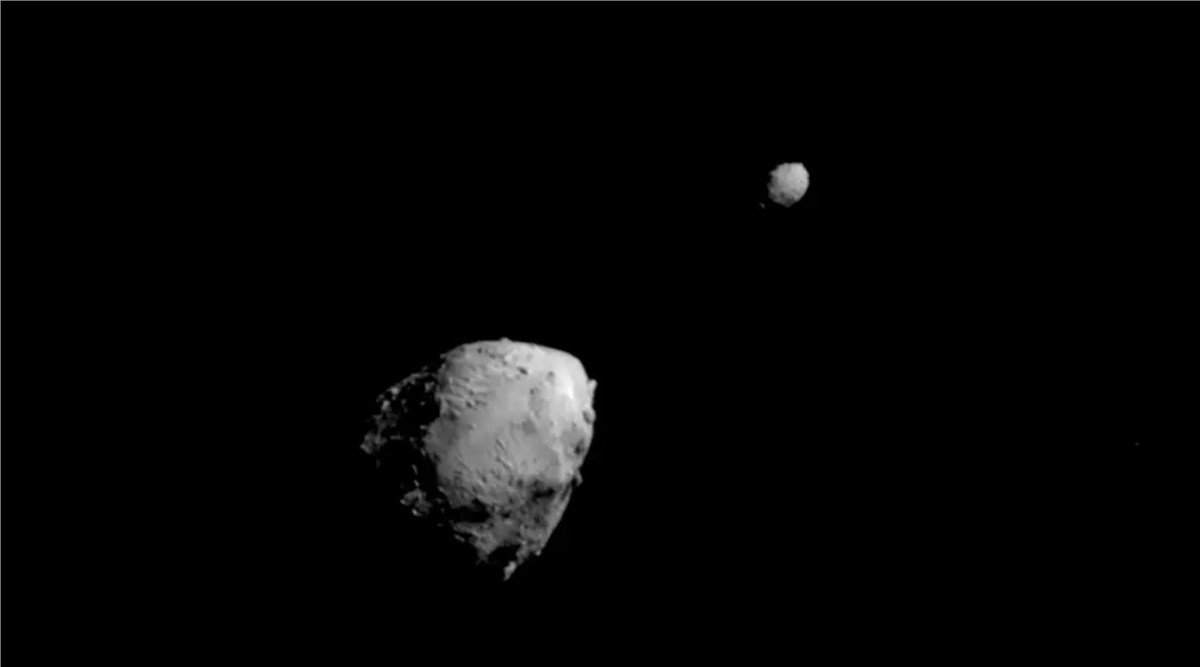
NASA’s DART mission was a bullseye, but its effects rippled far beyond the immediate target. While the world celebrated the successful deflection of the asteroid moonlet Dimorphos around its parent, Didymos, scientists have now discovered the crash sent a jolt through the entire two-body system, slightly altering their shared journey around the Sun.
According to a study in Science Advances, the impact in September 2022 changed the binary system’s 770-day orbit around the Sun by a fraction of a second. This monumental, albeit tiny, shift occurred because Didymos and Dimorphos are gravitationally linked; pushing one pushed them both.
The force behind this cosmic nudge came from more than just the spacecraft itself. When DART hit the 560-foot-wide Dimorphos, it blasted a massive plume of rocky debris into space. As this material shot away from the asteroid, it created a recoil effect, doubling the overall momentum of the impact. This extra “oomph” was enough to alter the system’s velocity around the Sun by a minuscule 1.7 inches per hour.
Proving this change required detective work. An international team of volunteer astronomers used a technique involving stellar occultations—watching asteroids briefly block the light of distant stars—to pinpoint Didymos’ orbit with incredible accuracy between 2022 and 2025. These measurements confirmed the orbital shift and helped scientists calculate the densities of the asteroids, revealing Dimorphos to be a loosely-bound “rubble pile.”
“It validates kinetic impact as a technique for defending Earth,” noted study co-lead Steve Chesley. Though Didymos was never a threat, the mission proves that with enough advance warning, a targeted impact could one day deflect a hazardous asteroid. NASA’s upcoming NEO Surveyor mission aims to provide that crucial early warning by scanning for hard-to-find dark asteroids that could pose a future risk.
