

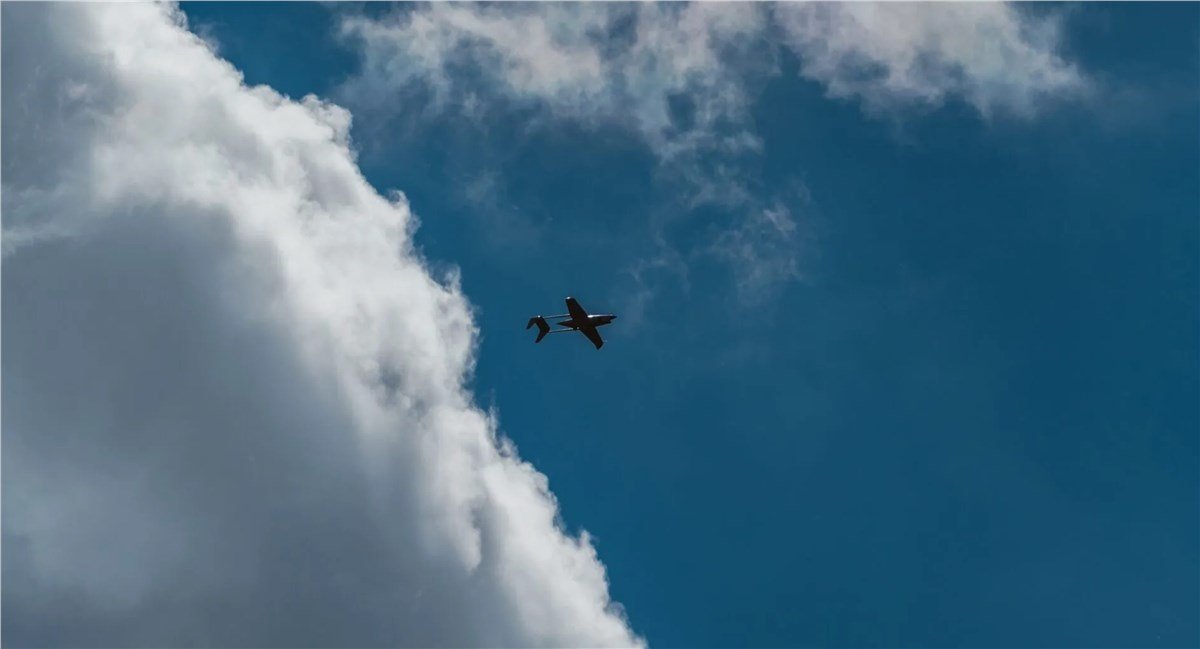
Ukrainian aviation manufacturer Skyeton has integrated a radiation sensor payload into its Raybird unmanned aerial system, enhancing the platform’s role in environmental monitoring and emergency response. The new capability allows for real-time aerial radiation detection, mapping, and data transmission over extended distances, combining the Raybird’s long-endurance performance with advanced sensing technology.
The gamma radiation detection module is installed within the UAV’s fuselage, maintaining aerodynamic balance and structural protection during long-duration missions. The system underwent operational testing in Ukraine’s Chornobyl exclusion zone, where it demonstrated stability and measurement accuracy in high-risk conditions.
In 2025, Skyeton delivered the first radiation-equipped Raybird system to the State Emergency Service of Ukraine, where it now supports continuous monitoring tasks as part of the national emergency response framework.
“The Raybird has demonstrated its reliability in the most hostile conditions,” said Roman Knyazhenko, CEO of Skyeton. “We rely on it to help make our home safer, and the integration of radiation monitoring capabilities was driven by that very need. Today, it is part of the national emergency response system.”
The sensor module integrates fully with the aircraft’s onboard systems and ground control interface, enabling operators to view radiation data alongside standard flight telemetry. Testing in the Chornobyl zone confirmed the system’s effectiveness in wide-area radiation reconnaissance, targeted hotspot detection, and stable long-duration data transmission across varying temperatures.
Beyond emergency response, the radiation monitoring configuration supports disaster management, industrial safety oversight, infrastructure inspection, and post-incident environmental assessment.
With over 350,000 accumulated flight hours in combat-proven operations across Ukraine, the Raybird continues to evolve as a modular platform capable of integrating specialized payloads while preserving its core operational strengths. The base ICE version offers 28+ hours of endurance, a 2,500+ km maximum range, and a 5,500 m operating ceiling. Real-time data transmission extends beyond 220 km, with satellite communication options for unlimited range. The system operates reliably in temperatures from -35°C to +55°C and can be deployed in under 25 minutes.
The Raybird supports interchangeable payloads including EO/IR gimbals, aerial cameras, synthetic aperture radar, radio frequency locators, and specialized sensors such as the newly integrated radiation monitoring module, ensuring mission flexibility across military and civilian applications.
