

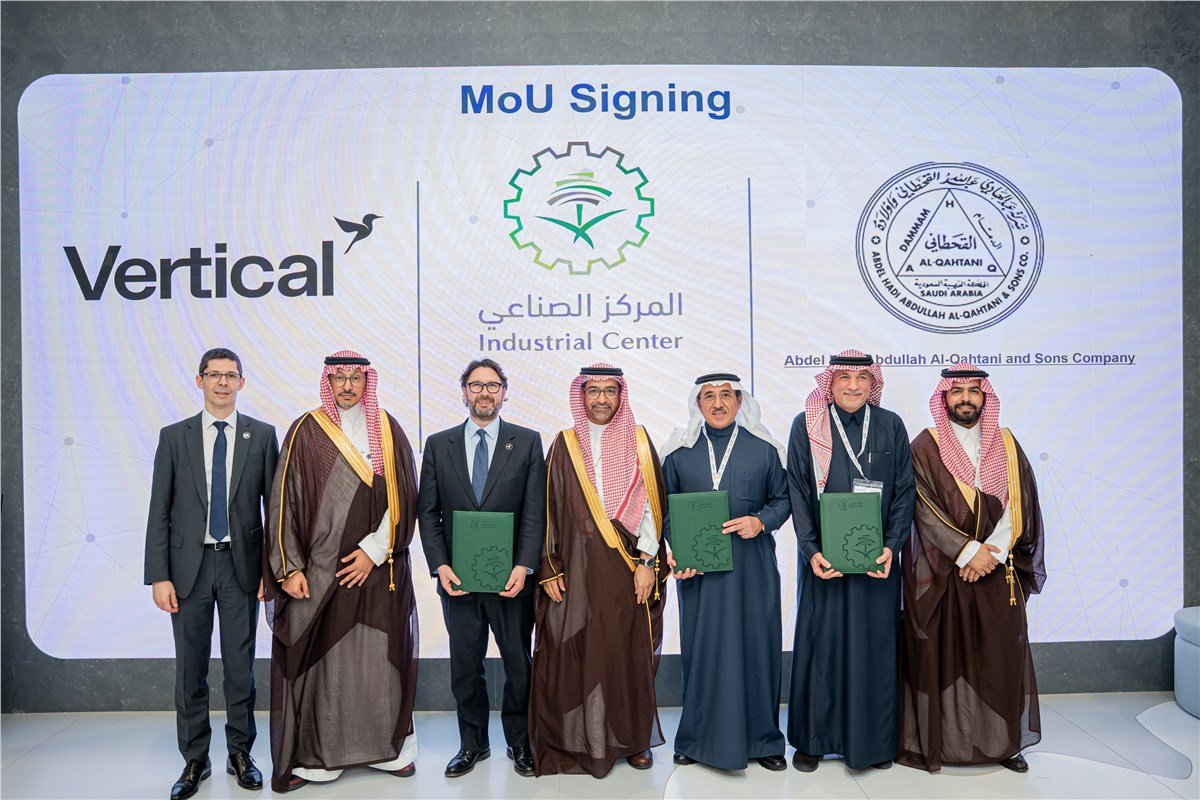
Vertical Aerospace has signed a strategic Memorandum of Understanding with Saudi Arabia’s AHQ Group and the National Industrial Development Centre (NIDC) to explore developing an Advanced Air Mobility (AAM) ecosystem in the Kingdom aligned with Vision 2030.
The three-party agreement, signed in Riyadh, establishes a framework to evaluate opportunities spanning manufacturing localization, commercial eVTOL operations, and potential investment incentives supporting Vertical’s certification programme. Saudi Arabia represents one of the largest emerging AAM markets globally, with potential to support over 1,000 Valo aircraft operations.
As a leading Saudi industrial conglomerate, AHQ Group will help assess industrial, commercial and investment structures needed to establish a scalable AAM ecosystem. Together with NIDC—part of the Ministry of Industry and Mineral Resources—the partners will explore positioning Saudi Arabia as a regional hub for electric aircraft manufacturing, battery systems and AAM services.
“This MoU reflects the Kingdom’s ambition to build world-class aerospace industrial capability under Vision 2030,” said Stuart Simpson, CEO of Vertical Aerospace. “Partnering with AHQ Group and NIDC brings together deep industrial expertise, capital strength and shared commitment to establishing Saudi Arabia as a regional leader.”
Chairman Tariq Abdel Hadi Al-Qahtani of AHQ Group added: “Through this MoU, we are exploring potential investment opportunities to build a competitive AAM ecosystem combining advanced manufacturing, sustainable mobility and long-term economic value.”
Eng Saleh Al Solami, CEO of NIDC, stated: “Advanced Air Mobility has potential to become a strategic industrial sector for Saudi Arabia. Working with Vertical and AHQ Group allows us to assess localisation pathways, positioning the Kingdom as a regional hub for next-generation aerospace technologies.”
Vertical’s Valo aircraft has been engineered specifically for hot environments, making it suitable for Saudi Arabia and the wider GCC region. The certification aircraft flies up to 160km at 240 km/h with zero operating emissions, meeting airliner-level safety standards. Key features include operation up to 50 degrees Celsius, advanced thermal management systems, and batteries installed in the fuselage—thermally isolated from solar radiation. A hybrid-electric variant offering increased range is also under development.
